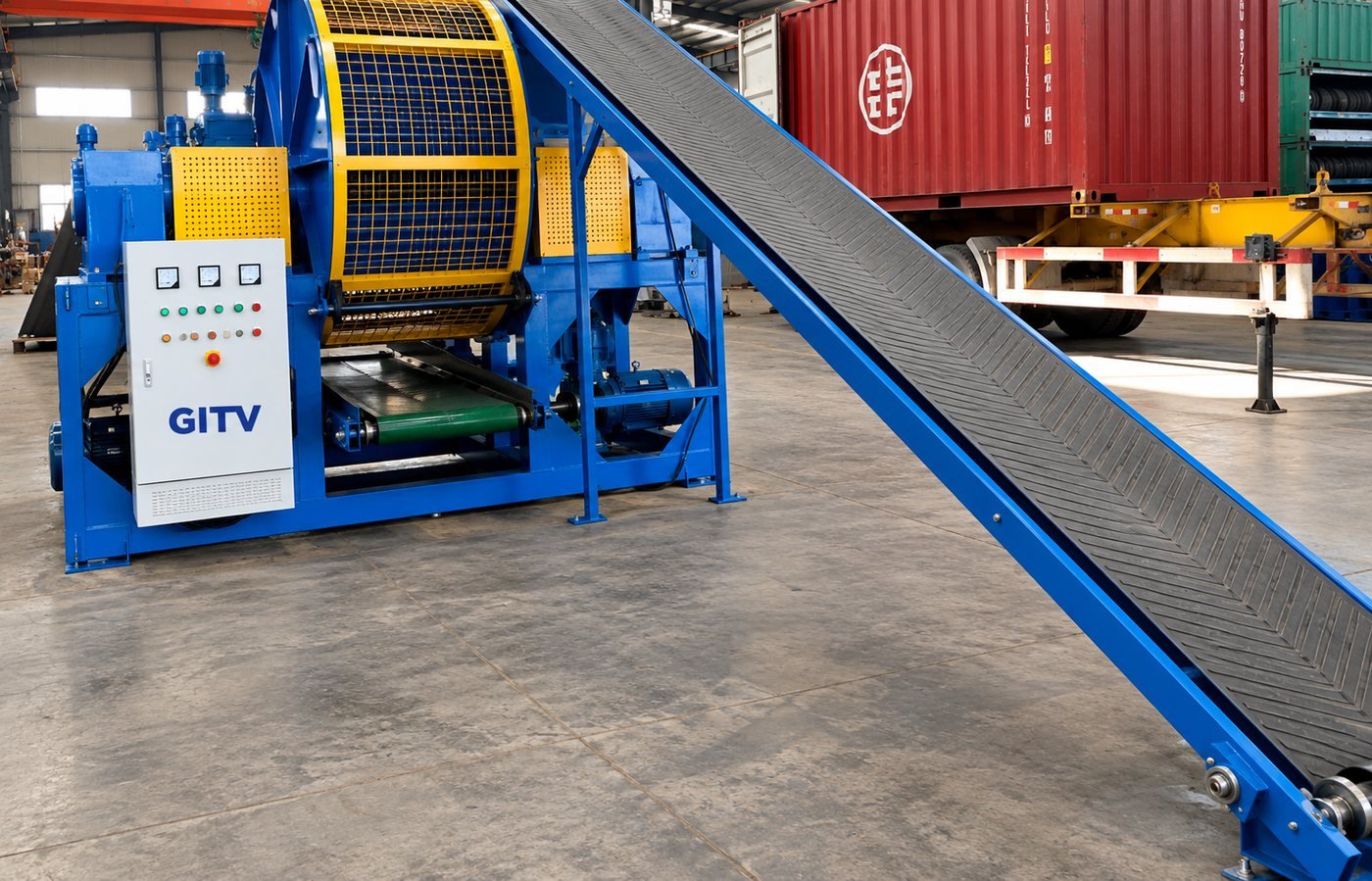
One line, two markets. The chip sells as TDF — alternative fuel for cement, paper and steel plants and for pyrolysis — and as TDA, civil engineering aggregate for lightweight fill, drainage and noise barriers. The same machine produces both by changing the screen.
1 · Start here
Nobody buys "a 3 tonne per hour shredder". You buy the capacity to process what arrives in the yard. Answer how many tonnes of tires you can source per month and the table tells you which machine is yours — everything else on this page is defined after that answer.
| If you source per month… | Your machine | Per shift 8 hours | Per month 1 shift | Equivalent to |
|---|---|---|---|---|
| Up to 150 tonnes | PS-F1 1 ton/hr | 8 t | 176 t | ~20,700 car tires or ~3,250 truck tires |
| From 150 to 450 tonnes | PS-F3 3 ton/hr | 24 t | 528 t | ~62,100 car tires or ~9,780 truck tires |
| More than 450 tonnes | PS-F5 5 ton/hr | 40 t | 880 t | ~103,500 car tires or ~16,300 truck tires |
Calculated on an 8-hour shift and 22 business days per month. The tonnage columns are nominal capacity; in real operation it is prudent to budget 85% for feed stoppages, blade changes and maintenance — which leaves 150, 449 and 748 tnes respectively.
Capacity is not only bought with steel, it is also bought with hours. The PS-F1 on three shifts processes 528 tnes a month — exactly the same as the PS-F3 on one.
If your constraint is tire supply and not the machine, starting small and growing with shifts leaves capital free for the granulation stage, where the kilo is worth several times more. If instead you already have the volume secured and want to run a single shift, the larger machine works out better on payroll cost.
PS-F1 · Entry level
1 t/h8 tnes per 8-hour shift
| Power consumption | 90 kW (120 hp) |
| Cutting chamber | 600 × 880 mm |
| Blade thickness | 38 mm (1.5") |
| Cutter diameter | 300 mm |
| Rotor diameter | 106 mm |
| Dimensions (L×W×H) | 2,100 × 1,000 × 2,000 mm |
| Hopper opening | 900 × 1,100 mm |
| Weight | 6,000 kg |
| Tires per shift | ~960 car tires |
PS-F3 · Small to mid-size operator
3 t/h24 tnes per 8-hour shift
| Power consumption | 188 kW (250 hp) |
| Grinding chamber | 890 × 1,320 mm |
| Blade thickness | 50 mm (2") |
| Cutter diameter | 400 mm |
| Rotor diameter | 152 mm |
| Dimensions (L×W×H) | 4,500 × 1,300 × 3,800 mm |
| Hopper opening | 1,900 × 1,100 mm |
| Weight | 9,800 kg |
PS-F5 · Established operator
5 t/h40 tnes per 8-hour shift
| Power consumption | 280 kW (375 hp) |
| Cutting chamber | 1,100 × 1,600 mm |
| Blade thickness | 50 mm (2") |
| Cutter diameter | 500 mm |
| Rotor diameter | 190 mm |
| Dimensions (L×W×H) | 5,200 × 1,600 × 4,200 mm |
| Hopper opening | 2,200 × 1,400 mm |
| Weight | 15,000 kg |
It is not chosen by budget: it is chosen by how many tires you can collect per month. A large machine running at half load costs the same in payroll and electricity as a properly sized one.
The practical rule: some clients prefer two 3 t/h machines instead of one 5 t/h, because one can rest while the other produces. The price rises a little and availability rises a lot.
A mining truck tire is up to 4 metres in diameter and weighs close to two tonnes. It fits no shredder and no debeader: it is cut first in the yard into pieces the size of a conventional tire. From there the line is exactly the one you are looking at here.
The cutter that solves that step is in complementary equipment, with its full technical sheet.
2 · Without these it does not run
They go with whichever shredder you choose. One feeds the tire in, the other takes the chip out — without them the machine has no way to be fed or to discharge.
Takes the whole tire and carries it to the shredder. Raised side skirts prevent spillage.
| Length | 6,000 mm |
| Belt width | 1,400 mm |
| Power | 3.7 kW |
| Belt | PVC |
| Capacity | 0 – 4,000 kg/h |
Evacuates the shredded material to storage or packing.
| Length | 7,000 mm |
| Belt width | 800 mm |
| Power | 2.2 kW |
| Belt | PVC |
| Capacity | 0 – 4,000 kg/h |
3 · The only open decision at this stage
Suenan igual y no son lo mismo. La criba es una malla dentro del triturador y va incluida siempre — sin ella la máquina no puede garantizar medida. La cernidora es una máquina aparte, con motor propio, y ésa sí es una decisión.
Only when you sell chip and your buyer demands a uniform fraction. If the chip goes straight to granulation, the shredder screen is enough and the classifying screen adds nothing.
If that is your case, the technical sheet and scope are in complementary equipment.
4 · The second question
That answer determines whether you need bead equipment. It is not a budget question: the steel in a car tire and in a truck tire are different problems, and one of the two is not a problem at all.
| What you receive | What you need before the shredder |
|---|---|
| Car and pickup | Nothing. Their bead steel is thin and the shredder processes them with the rim inside. This is the case for most urban collection yards. |
| Truck and trailer | A debeader. The thick bead punishes blades, so it is worth removing it first — or recovering that steel separately. |
| Mining or OTR tire | A pre-cutter. A tire of up to 4 m fits no shredder: it is cut in the yard into conventional-sized pieces. |
Debeaders, cutters and the classifying screen are not part of the shredding system and are not hidden inside its price. Each has its own technical sheet, capacity and purchase criteria in complementary equipment.
4-bis · So there is no doubt
This is how your quotation is built. Each module is quoted separately — we do not sell closed packages, because every operation is different. This table is so you know exactly what you are buying and what you can remove.
| Module | What it does | PS-F1 1 t/h | PS-F3 3 t/h | PS-F5 5 t/h |
|---|---|---|---|---|
| Twin-shaft shredder | The machine that sets your capacity. It is the decision that defines everything else. | Mandatory | Mandatory | Mandatory |
| Shredder screen | Internal mesh that defines the chip size. Without it there is no guaranteed sizing. | Built in | Built in | Built in |
| Feed belt | Takes the whole tire and carries it to the shredder. | Mandatory | Mandatory | Mandatory |
| Discharge conveyor | Evacuates the chip to storage or packing. | Mandatory | Mandatory | Mandatory |
| Horizontal transfer conveyor | Internal transfer. Only on the PS-F1: on the other two the discharge conveyor covers it. | Included | Not applicable | Not applicable |
| Sizing separator | Size separator with its own motor. Only if you sell chip to a cement plant — if you will granulate it is not needed. | Depends on destination | Included | Included |
| Hydraulic debeader | Extracts the radial steel from the bead. Justified by truck tires. | Optional | Optional | Optional |
| Sidewall remover | Separates the sidewall from the tread before shredding. | Optional | Optional | Optional |
| Strip cutter | Cuts the tire into strips before the shredder. | Free of charge | Optional | Optional |
Shredder, feed conveyor and discharge conveyor are the three that cannot be left out: one feeds the tire in, one reduces it, one takes it out. Without any of the three there is no line, only a machine standing still.
The screen goes inside the shredder and is not quoted separately. It is part of the machine, not an accessory.
The debeader and the sidewall remover solve the same problem — bead steel — by different routes. If you process car tires, neither is necessary: their bead is thin and the shredder passes it without trouble.
If you will granulate later, there is a third route: let the steel through and remove it at the stage 2 magnetic separator.
5 · How it is operated
These are the answers we give on every client visit. They serve to size the business before talking price.
A figure that changes your projection: one tonne of whole tires does not produce one tonne of rubber. Once radial steel and textile fibre are separated, the material drops by around 30%. If you will granulate, calculate on 700 kg of rubber per tonne of tires going in — the rest is sold separately as steel and fibre, but not as rubber.
6 · The raw material
Tires shredded into uniform 2 to 3 inch fragments, used as alternative fuel in high-temperature kilns. Its calorific value is comparable to coal.
Replaces up to 10% of the kiln's main fuel in co-processing.
The steel melts and is incorporated into the clinker, leaving no residual ash.
It reduces the kiln's carbon footprint and keeps tires out of open dumps.
7 · The market
The cement plant is the best-known buyer, but not the only one — and today not always the best. Chip has two distinct markets: as alternative fuel and as civil engineering aggregate. It pays to enter knowing both exist.
As alternative fuel · TDF
Co-processing in the rotary kiln: it replaces up to 10% of the fuel and the steel goes into the clinker. It is more than half of world TDF consumption.
Pulp and paper mill boilers. It is the fastest-growing segment of the global TDF market, ahead of cement.
High-temperature furnaces and processes where the tire's carbon and steel contribute to the process, not just heat.
Its calorific value is around 15,000 Btu/lb, above many solid fuels, with a stable moisture content.
They buy chip as feedstock to recover oil, carbon black and steel. This is an industrial buyer, not a burner.
Anyone running granulation needs chip as input. You can sell to another recycler instead of competing with them.
As civil engineering aggregate · TDA
Embankments and fills over soft ground. It weighs a fraction of stone aggregate and reduces lateral load on retaining walls.
High permeability. Used as a drainage medium in road works and in landfill leachate and gas collection systems.
Vibration damping on railway track and acoustic barriers. A property stone aggregate does not have.
Insulating layer beneath pavement in freeze-thaw zones, and in foundations that require it.
8 · How it is delivered
STEP 1
Before manufacturing we send a team of technicians to your plant for a full survey: available electrical capacity in kVA, voltage, energy type, cable length and gauge per motor, and what must be modified to receive the line. This survey is free of charge.
STEP 2
Flow diagram according to your floor area: linear, at 90° or zigzag. Every plant needs four areas: reception with a manoeuvring yard, process, finished product and services.
STEP 3
60 to 80 business days from the down payment, under ISO 9001:2015.
STEP 4
Installation, commissioning and on-site training. Every motor with start/stop and thermal protection from a central unit.
One year on manufacturing defects under normal use. Six months on motors and electrical material, with the machines protected against voltage fluctuations.
During the term, parts on the spare parts list are free of charge; shipping is borne by the buyer.
Included: machinery, shipping, installation, commissioning and training of the operating crew. Spare parts are made in Mexico — you do not depend on imports for a part.
Client's responsibility: electrical substation, transformer and utility contract. We connect from there onwards. Also the building's civil works and transport to your plant.
The commercial proposal is delivered separately, sized to your project.
Tell us how many tires you receive per month or how much TDF your buyer is asking for, and we will size the complete circuit with a technical and commercial proposal.
Where it is built
Grupo Industrial TV builds this machinery in Ciudad Sahagún, Hidalgo, ninety minutes from Mexico City. You can visit the plant and see the process before you decide.
See the plant →Document the operation
ELTrack records where the tyre comes from, where it goes and how it ends up. It is the system used to document compliance.
Discover ELTrack →Quote
Tell us what capacity you need and we will put the proposal together.
✅ Request received. We will contact you within 24 hours.
¿Tienes prisa? Message us on WhatsApp →