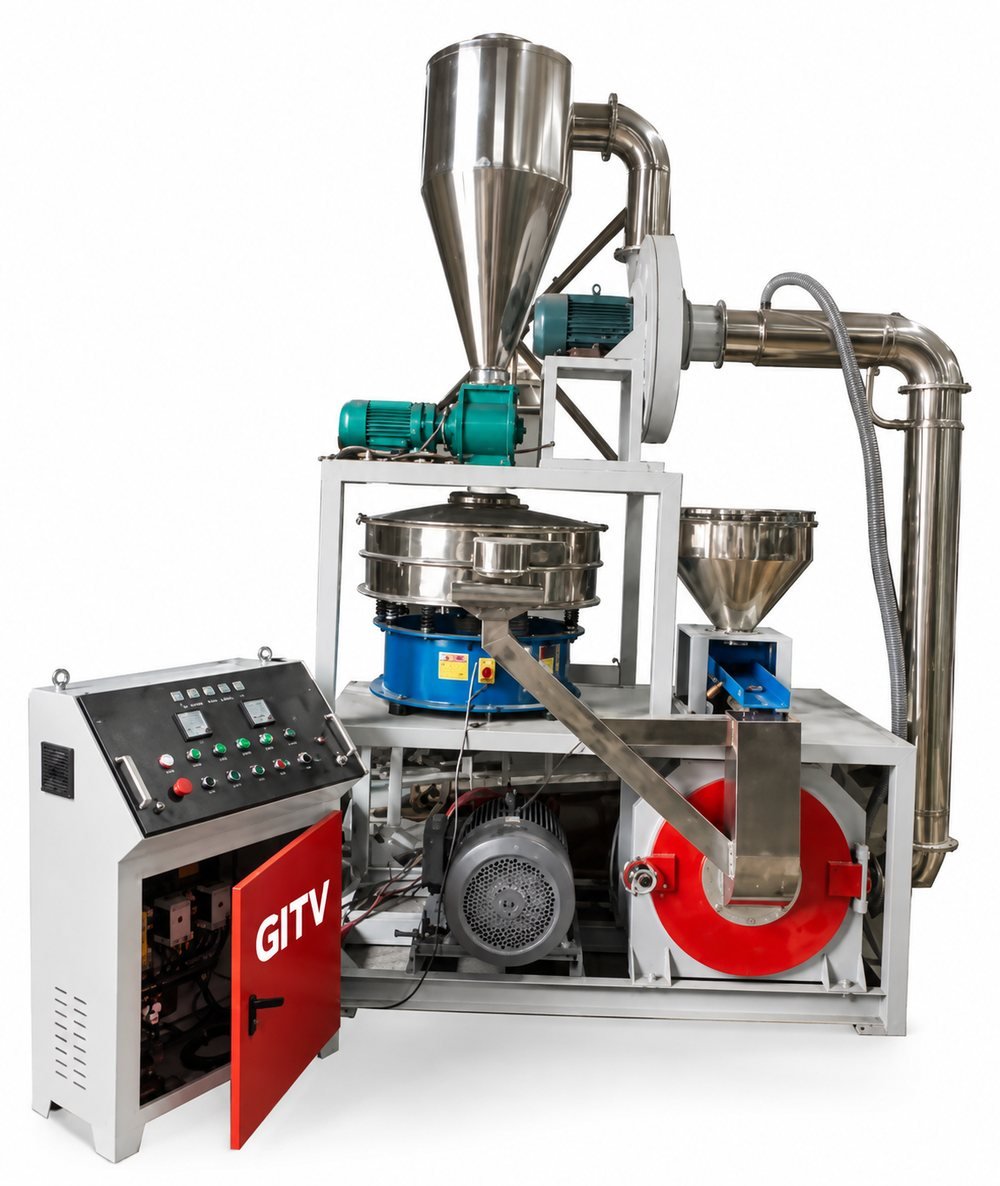
The last step of the process and the highest value per kilo. A single machine, with water cooling and an adjustable screen, that turns granulate into fine-mesh powder.
1 · Start here
This stage is decided by fineness, not capacity. There is only one machine; what changes is the mesh you produce, and that mesh defines which industry you can sell to. Before looking at the datasheet, answer this.
Close to granulate. It goes to asphalt mixes, sports surfaces and fills. The highest-volume range and the easiest to produce.
If your buyer is here, you may not need to micronise at all: check whether granulate straight from stage 2 works for them.
The most common working range. It enters waterproofing, paints, adhesives and moulded parts. This is where micronising starts to pay for itself.
It is also the mesh used to make polyurethane-resin waterproofing.
The highest value per kilo in the whole chain. It goes to rubber compounds, soles, sealants and applications where the powder replaces virgin rubber.
Lower output per hour: the finer it gets, the more passes and the more energy per kilo produced.
The machine runs a closed circuit: it feeds, pulverises, screens, and returns whatever missed the size to be pulverised again. The finer the mesh you ask for, the more laps the same kilo makes — so hourly capacity falls as fineness rises.
That is why you do not buy "a microniser of so many kilos". You buy the mesh your buyer asks for, and the kilos follow from that.
A single machine closes the stage. It takes granulate from the previous line and reduces it to powder, with output size controlled by an adjustable vibrating screen.
Reduces granulate to powder by friction, with water cooling and an adjustable-diameter screen. It is the machine that defines which market you can enter, because the mesh range determines the buyer.
| Capacity | 80 – 100 kg/hr |
| Motor | 30 kW |
| Voltage | 440 / 220 V |
| Enfriamiento | Water-cooled |
Water cooling. Pulverising generates frictional heat, and heat is rubber's enemy: it degrades it. This machine's cooling system uses water, not air.
Adjustable screen from 20 to 80. Output size is not fixed at the factory. The screen is adjusted to the powder the client asks for, which is why one machine covers a wide mesh range instead of a single size.
The machine runs at 80 to 100 kg/h. Against the 600 to 1,500 kg/h of the granulation line, that is a far slower pace — because the product is also worth far more per kilo. The right question is not how much it produces, but at what mesh and to whom you will sell it.
2 · Decision 2
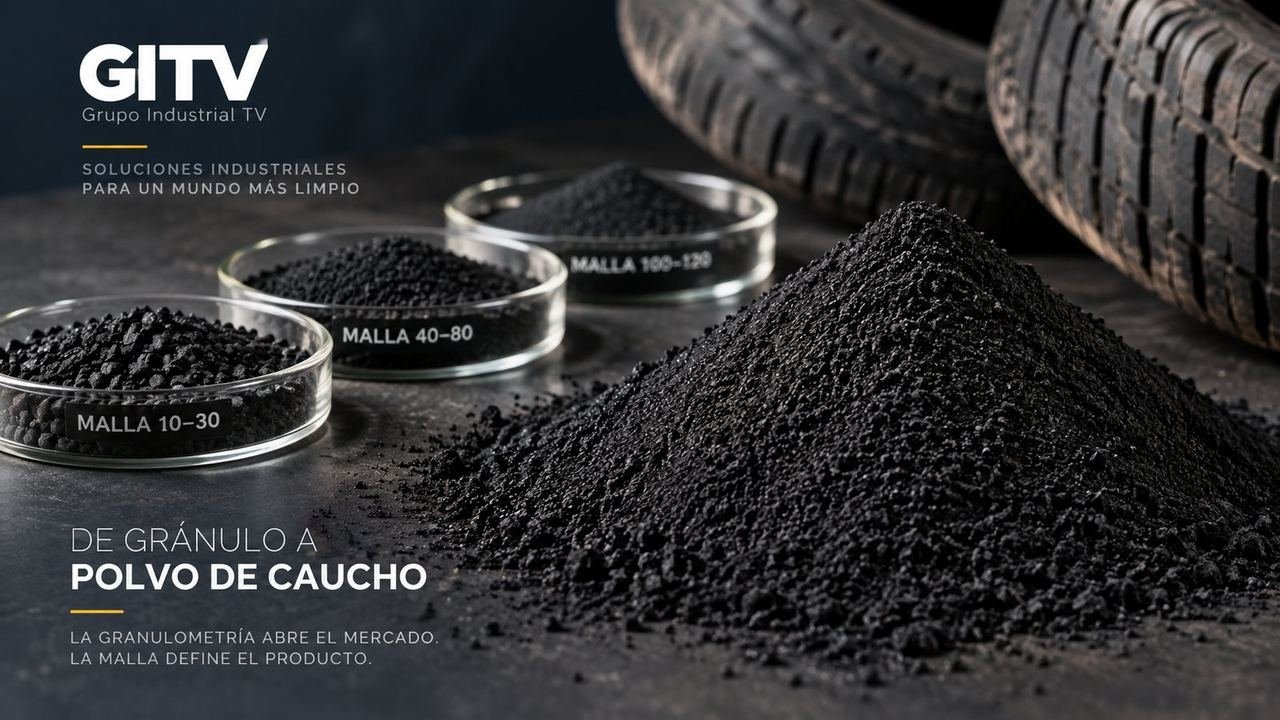
The machine includes one screen, and you decide its mesh. This is not a configuration detail: that mesh defines which market you enter from day one, because each industry asks for a different range and will not take the neighbouring one. Additional screens are sold separately and are low cost.
| If you choose this mesh… | You can sell to | What to expect |
|---|---|---|
| Mesh 10 – 30 Coarse powder | Asphalt plants, sports surfaces, fills and shock-absorbing bases. | The highest hourly output in the whole range. This is the volume mesh. |
| Mesh 40 – 80 Medium powder | Waterproofing, paints, adhesives and moulded parts. This is the mesh for polyurethane-resin waterproofing. | The most common working range and the best balance between price and output. |
| Mesh 100 – 120 Fine powder | Rubber compounds, soles, sealants and applications where the powder replaces virgin rubber. | The highest value per kilo. Also the lowest output: more passes for the same kilo. |
If you already have a buyer, ask for their specification and that is your mesh, no debate. If you do not have one yet, start with medium mesh — the 40 to 80 range — because it has the highest demand and the best balance of price and output.
Starting at the fine end with no buyer locked in is the costliest mistake: you produce little per hour and the order that would justify it does not exist yet.
Screens are sold separately and are a low-cost consumable, not equipment. They are changed on site, without modifying the machine and with no more downtime than the change itself.
That means the mesh you choose at purchase does not lock you in: it defines where you start. When a buyer with a different specification shows up, you order the screen from us and carry on with the same machine.
Do you already have a buyer identified, or will you produce first and look for one later? If you have one, ask for their mesh specification and that is your starting screen, no debate. If not, start with medium mesh — the one in highest demand — and buy the next when you know who you will sell to.
It is the only decision in this stage that money cannot fix later: you can change the mesh, but you do not get back the months you spent producing something nobody bought.
3 · Datasheet
One machine, no capacity variants. What is adjusted is the screen, not the machine.
TS-P80 · Microniser
80 – 100 kg/hrPowder from 10 to 120 mesh
| Capacity | 80 – 100 kg/hr |
| Powder mesh | 10 – 120 mesh |
| Vibrating screen diameter | 20 – 80, adjustable |
| Motor | 30 kW |
| Voltage | 440 / 220 V |
| Cooling method | Water |
| Input material | Rubber granulate |
Figures come from the machine datasheet. Dimensions and installation requirements are defined in the project proposal.
How to read the mesh
10 – 120Openings per linear inch in the screen
| Low mesh (10 – 30) | Coarse powder, close to granulate |
| Medium mesh (40 – 80) | Most common working range |
| High mesh (100 – 120) | Fine powder, higher value |
The higher the number, the finer the particle and the more valuable the product. The machine covers the full range by adjusting the screen, so a single asset serves several markets.
4 · The raw material
Rubber powder in a 10 to 120 mesh range. That range is what makes the machine sellable: each industry buys its own mesh, and here you cover coarse through fine with the same asset.
The powder reaches the market as black powder, which goes into finished product, and as colour-pigmented powder. Same machine and same input; what changes is the colouring process and the market it is delivered to.
That is why micronising is assessed differently from earlier stages: not by tonnes produced, but by which presentation you can place and with which client.
5 · The market
Here the buyer changes completely from granulate. Micronised powder is not sold as decorative fill: it is sold as raw material to the rubber and plastics industry, which incorporates it into their own formulations.
Shoe soles, gaskets, seals, joints, technical profiles and anti-vibration parts. The powder enters as filler in the formulation, replacing virgin rubber.
Hoses, conveyor belts, transmission belts, cable jacketing, industrial mats and roller coverings.
Waterproof membranes and asphalt coatings with recycled rubber. In Mexico this is already an established commercial category in the paints and coatings market.
The tire industry incorporates micronised powder as filler in tire compounds. It is the most demanding buyer on consistency and the one that moves the most volume.
With surface treatment, the powder is incorporated into thermoplastic matrices at loadings of roughly 15 to 30% by weight for injection-moulded parts.
Pavement and asphalt shingle formulations. The highest-volume use of coarse powder, and the most tolerant of mesh variation.
The point that wins the sale: an industrial buyer is not impressed by how many tonnes you produce. What matters is that the mesh you deliver today is the same next month, because your powder goes into their formulation. Whoever holds the specification keeps the contract — and that is why water cooling matters: heat degrades rubber and shifts the product's characteristics.
6 · How it is delivered
What the current quotation for this machine defines, with no assumptions.
Eighteen months on all manufacturing defects arising from normal use of the machinery. It does not cover problems from incorrect or improper maintenance or use.
Six months on motors, electrical parts and accessories and on electrical material generally, provided the machine is properly protected against voltage fluctuations.
During the warranty period, parts on the spare parts list are covered at no cost. Shipping costs are borne by the buyer.
Included: shipping, installation, commissioning and training of the operating crew.
Client's responsibility: electrical substation, transformer and utility contract. We connect from there onwards, plus civil works and transport to your plant.
The starting figure for sizing is the machine's power: 30 kW at 440/220 V. Before manufacturing we send technicians to survey your site, free of charge, to determine what preparation is needed.
Lead time: 60 to 80 business days from the down payment.
The commercial proposal is delivered separately, sized to your project.
Tell us what mesh your buyer needs, what volume they are asking for and whether you already run granulation. With that we size the machine and the previous stage if needed.
Where it is built
Grupo Industrial TV builds this machinery in Ciudad Sahagún, Hidalgo, ninety minutes from Mexico City. You can visit the plant and see the process before you decide.
See the plant →Document the operation
ELTrack records where the tyre comes from, where it goes and how it ends up. It is the system used to document compliance.
Discover ELTrack →Quote
Tell us which mesh your buyer requires and we will put the proposal together.
✅ Request received. We will contact you within 24 hours.
¿Tienes prisa? Message us on WhatsApp →