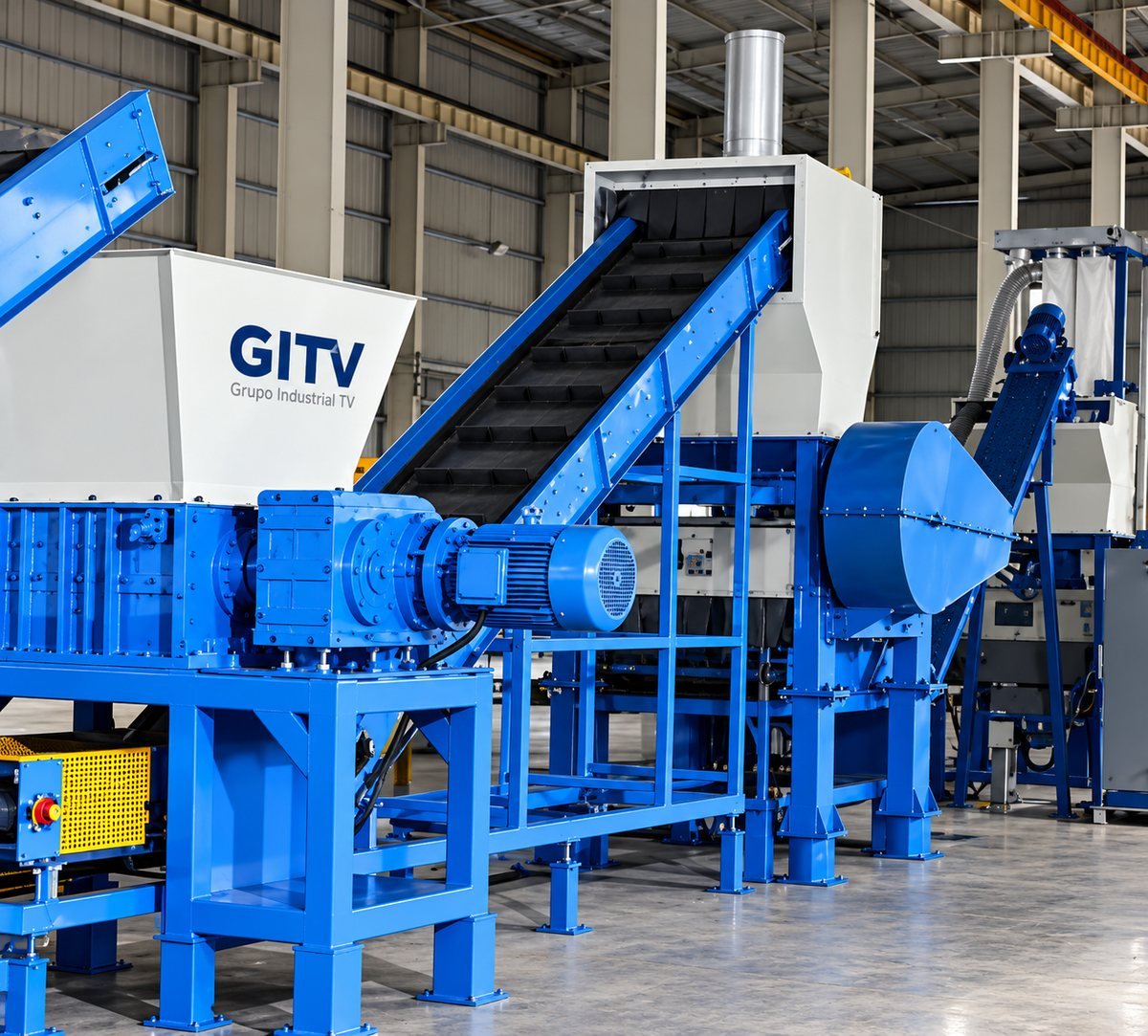
The chip is no longer the product: it is the raw material. First you choose the line capacity, then the machines that make it up — and if you want, the equipment to sell finished product instead of bulk granulate.
1 · Start here
That is the question that decides whether granulating is worth it. The same tonne of tire is worth very different amounts depending on how far you take it — and what separates one step from the next is a machine, not a different client.
It is a commodity. You sell by the tonne to cement plants or civil engineering, and the buyer sets the price because any yard with a shredder produces the same thing.
Lower investment, and also lower margin per kilo.
You change market. Granulate from 1.5 to 4 mm goes into sports flooring, synthetic turf, asphalt mixes and moulded parts. You no longer compete against every collection yard.
It is four modules on top of what you already have. You do not buy a shredder or conveyors again.
You stop selling raw material. Pavers, tiles and mats sell by the piece, not by the kilo, and there you set the price.
A vulcanising press on the same line. It is in section 4.
We reviewed published prices of recycled rubber and finished product on Mexican industrial portals. The finding is more useful than the usual "it is worth five times more": price depends more on volume and specification than on the process stage.
| How you sell it | Qué define el precio | Frente al granel |
|---|---|---|
| Bulk granulate | Pedidos grandes, sin especificación. El comprador pone el precio | Punto de partida |
| Granulate in mid-size orders | Monthly or quarterly volumes con entrega comprometida | 2 a 4 veces más |
| Specified granulate | Malla controlada, sin fibra, con certificado de lote | 4 a 10 veces más |
| Standard tile or paver | Se vende por pieza y por metro cuadrado, no por kilo | 2 a 9 veces más |
| Specialty product | Piso ecuestre y aplicaciones técnicas con requisito de desempeño | Hasta 20 veces más |
The honest reading: selling in bulk puts you at the market floor, and there it makes no difference how much you processed. The price jump does not come from the machine alone — it comes from specifying the product and finding the buyer who pays for that specification. A tonne of granulate with controlled mesh and no fibre is worth several times a tonne of generic granulate.
Múltiplos de referencia sobre el gránulo a granel como base, construidos a partir de precios publicados en portales industriales mexicanos. No publicamos importes porque el precio real depende de tu región, tu volumen y tu comprador — estas proporciones sirven para decidir hasta dónde procesar, no para proyectar ingresos.
The granulator sets the pace of the whole line, so it is the decision that defines the rest. It changes more than hourly output: it changes the tire diameter you can process without pre-cutting and the floor space you will need.
SS-C800 · Entry into the granulate market
600 – 800 kg/hrGranulate from 1.5 to 4 mm
| Max. tire diameter | ≤ 800 mm |
| Truck tire | Requires pre-cutting with a guillotine |
| Minimum floor space | 420 m² |
| Operators | 4 |
| Full line consumption | 150 kW · 199 HP · 187 kVA |
| Suggested substation | 300 kVA |
| Rasper mill | 30 kW |
| Granulator mill | 22 kW · 600 kg/hr |
| Granulator input / output | 3/4" → 1.5 – 4 mm |
| Granulator blades | D2 steel (Cr–Mo–V) |
| Noise level | 80 – 90 dB at 1–2 m |
| Lead time | 60 business days |
| Installation | 20 to 30 days |
For those already running shredding who want to move a value step up without committing to a large building.
SS-C1500 · Volume operation
1,300 – 1,500 kg/hrGranulate from 1.5 to 4 mm
| Max. tire diameter | ≤ 1,200 mm |
| Truck tire | Enters directly |
| Minimum floor space | 560 m² · 14 m frontage |
| Operators | 4 |
| Full line consumption | 222 kW · 296.5 HP · 278 kVA |
| Suggested substation | 500 kVA |
| Rasper mill | 45 kW · 1,900 kg/hr |
| Granulator mill | 37 kW · 1,200 kg/hr |
| Granulator input / output | 3/4" → 1.5 – 4 mm |
| Granulator blades | D2 steel (Cr–Mo–V) |
| Noise level | 80 – 90 dB at 1–2 m |
| Lead time | 60 to 80 business days |
| Installation | 20 to 30 days |
The same crew of 4 operators produces almost double. And by accepting tires up to 1,200 mm without guillotining, it eliminates a whole labour step and the machine that does it.
Both lines run with four operators. The payroll is practically the same, but the SS-C1500 produces almost double per shift. If your intake includes heavy truck tires, the cost per tonne processed falls far more than the equipment difference suggests.
Consumption and floor space figures refer to the complete line, from tire to granulate — including the shredding stage equipment.
2 · The machines in this stage
The granulator mill is not listed here because you already chose it above: it is the machine that defines the line capacity. These are the three added to it. Stage 2 is four modules in total — rasper mill, conveyor with magnetic separator, granulator mill and vibrating conveyor with dust extractor — and they are quoted separately from stage 1. If you already have a primary shredder, you only buy these four: you do not pay again for a debeader, conveyors or shredder.
Reduces the fragment from 4" to 3/4" and releases the steel from the rubber. Its torque is sized for heavy truck tires, where the steel content is higher.
| Power | 40 HP (30 kW) |
| Torque | 55,000 psi |
| Rotor diameter | 350 mm |
| Rotor speed | 110 rpm |
| Output screen | 10 – 12 mm |
| Blade material | D2 steel (Cr–Mo–V) |
| Capacity | 580 – 700 kg/hr |
| Weight | 3,200 kg |
Moves the material to the mill and removes loose wire on the way. It is what guarantees steel-free granulate — the buyer's number one criterion.
| Length | 4,000 mm |
| Belt width | 800 mm |
| Motor | 1.5 kW, 2 HP gearmotor |
| Separation efficiency | 99% |
| Belt | PVC |
Once down to millimetre size, the tire's three components come apart. This module performs fine steel separation with a magnetic drum while removing the dust generated.
| Conveyor motor | 0.75 kW |
| Extraction turbine | 2.2 kW |
| Rotary valve | 30:1 reducer, 1.5 kW |
| Velocidad | 760 rpm |
| Dimensions | 900 × 500 × 1,000 mm |
3 · What comes included
They are part of the line and essential for the product to come out sellable, but they are not sold as standalone equipment: they come integrated in whichever configuration you choose.
A client who sees the list usually asks whether modules can be removed to lower the investment. The honest answer: the separation components are not accessories, they are the product. Nobody buys granulate with wire or fibre at granulate price — it sells as chip, and then the line was not worth it.
4 · Optional, and where the money is
Bulk granulate competes on price and there the buyer rules. Turning your own granulate into a part changes the unit of sale: you stop charging by the tonne and start charging by the square metre, which is where you set the price.
Múltiplos sobre el gránulo a granel como base. No publicamos importes: el precio real lo fija tu región, tu volumen y tu comprador. Y el salto no lo da la prensa por sí sola: lo da vender producto especificado a un comprador que paga por esa especificación. Un adoquín genérico rinde menos que gránulo bien especificado.
Two-layer hydraulic press to make rubber pavers, tiles and mats from your own granulate.
| Vulcanising chamber | 500 × 500 mm · 2 layers |
| Nominal clamping force | 0.8 MN |
| Piston diameter | 250 mm |
| Piston stroke | 250 mm |
| Distance between platens | 125 mm |
| Hot platen pressure | 3.2 MPa |
| Power | 2.2 kW |
| Closing and opening speed | ≥ 12 mm/s |
| Dimensions | 1,800 × 550 × 1,600 mm |
| Weight | 2,000 kg |
The mixer blends the granulate with the resin before pressing. Supplied with four moulds of different geometry.
| Mixer motor | 3.7 kW |
| Diámetro | 800 mm |
| Material | Stainless steel |
| Moulds included | 4 pieces of 500 × 500 mm × 2" |
We also teach you to make your own waterproofing using rubber as a base, combined with polyurethane or acrylic resin. That requires powder at mesh 40 — that is, stage 3.
Pavers in various geometries, tiles, rubber mats and surfaces for sports and play areas. It is the step that turns your operation from selling raw material to selling branded product.
Nota de entrega: este equipo tiene un esquema de pago propio, distinto al de las líneas de proceso, y su cotización se maneja aparte. Se detalla en la propuesta económica.
5 · The raw material
Rubber granulate from 1.5 to 4 mm at 99% purity, free of steel and nylon, ready to sell. Steel and fibre are also recovered and sold separately.
The final granulate is defined by the screen fitted in the mill, not the machine model. The same line can deliver coarse product for fill or fine for mixing — you change the screen, not the asset.
That is why it pays to agree the exact size with the buyer before starting production: it is the fastest way a batch gets rejected.
6 · The market
Granulate has more outlets than chip, and each industry asks for its own size. What defines who you sell to is not volume: it is the grain size you can sustain.
Infill for artificial turf on football pitches. It asks for fine granulate, around 0.5 to 2.5 mm, and is one of the markets that moves the most steady volume.
Poured-in-place flooring for play areas, where certified fall height is required. Typical range 1 to 4 mm — exactly what this line produces.
Gyms, industrial anti-fatigue mats, roof tiles, stable flooring, automotive and boot mats. This is finished product and pays far better than bulk granulate.
Pressed and moulded parts: wheel stops, dock bumpers, anti-vibration mounts, rubber road signage. The size is set against the client's mould.
Wearing courses and porous asphalt. It improves traction and flexibility and reduces rolling noise. High volume and more tolerant of size variation.
Riding arenas and horse walkers, with a mix of sand and coarse granulate. A small but stable niche that rarely competes on price.
Where the margin is: black bulk granulate is a commodity and competes by the tonne. Pigmented granulate is another commercial category — same machine, same input, different market — and finished product (tile, mat, poured floor) is where the business really changes: you stop selling raw material and start selling branded product.
7 · How it is delivered
STEP 1
Before manufacturing we send a team of technicians to your plant for a full survey: available electrical capacity in kVA, voltage, energy type, cable length and gauge per motor, and what must be modified to receive the line. This survey is free of charge.
STEP 2
The machinery adapts to the space: linear, at 90° or in a "U" shape. Defined before manufacturing, not after.
STEP 3
60 to 80 business days depending on capacity, with Siemens motors and Yaskawa control. Manufactured in Mexico.
STEP 4
20 to 30 days of installation, commissioning and training of the operating crew at your plant.
One year on manufacturing defects under normal use. Six months on motors and electrical material, provided the machines are protected against voltage fluctuations.
During the term, parts on the spare parts list are free of charge; shipping is borne by the buyer.
Included: machinery, shipping, installation, commissioning and training of the operating crew. Spare parts are made in Mexico — you do not depend on imports for a part.
Client's responsibility: electrical substation, transformer and utility contract. We connect from there onwards. Also the building's civil works and transport to your plant.
The commercial proposal is delivered separately, sized to your project.
Tell us how many tires you collect per month, what type they are and how much floor space you have. With that we size the complete line and deliver a technical and commercial proposal.
Where it is built
Grupo Industrial TV builds this machinery in Ciudad Sahagún, Hidalgo, ninety minutes from Mexico City. You can visit the plant and see the process before you decide.
See the plant →Document the operation
ELTrack records where the tyre comes from, where it goes and how it ends up. It is the system used to document compliance.
Discover ELTrack →Quote
Tell us the particle size and volume you need.
✅ Request received. We will contact you within 24 hours.
¿Tienes prisa? Message us on WhatsApp →